Mittsual Containment Measures
The Deer KingMittsual Containment Measures are the precautions developed around Hohsalle’s investigation of black wolf fever, a potentially lethal disease associated with bites from wolves or wild mountain dogs and, under some conditions, fleas and ticks. The measures join immediate safeguards—careful handling of corpses, washing and changing clothes, and isolation planning—to a longer effort to identify transmission routes and develop preventive treatment. Their defining feature is caution under uncertainty: the disease’s danger is clear before its full epidemiology is understood.
Evidence and Immediate Precautions
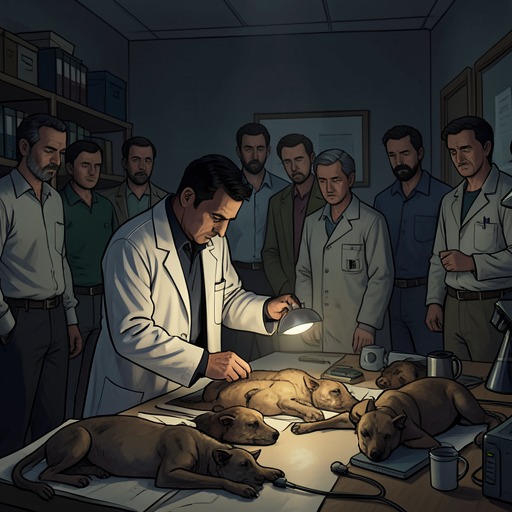
At the salt mine, Hohsalle interrupts the burning of the dead not to prevent cremation, but to examine bodies before they are destroyed. He agrees that cremation is necessary to contain illness, yet insists on inspecting the corpses first. The distinction matters: containment cannot substitute for investigation when the cause of a disaster remains uncertain. He finds dog-bite marks and a rash across the bodies, clues that shift attention away from the initial suspicion of poisoned food and toward an illness transmitted by bites.
Hohsalle has the five bodies laid out sprayed with mikimu, an insecticide made from powdered minerals. Wearing gloves, he directs Makokan to help undress them and warns him to look for fleas or ticks concealed in the clothes. The procedure treats the bodies not simply as remains to dispose of but as possible sources of vectors requiring controlled examination. Hohsalle also uses the bodies’ condition to estimate that death occurred about four days earlier, making time and exposure conditions part of the risk assessment.
The cold has limited the immediate danger, but does not remove it. Hohsalle explains that black wolf fever can be transmitted by wolves and ossam, and that fleas or ticks that have bitten infected animals or people can carry it onward. Frost has kept insects largely dormant; the bodies have been isolated in freezing conditions for more than four days, and no fires have been lit to create warm refuges. On that evidence, he judges that the disease will not spread from the corpses at the site. His reassurance is conditional, not a declaration that the illness is harmless.
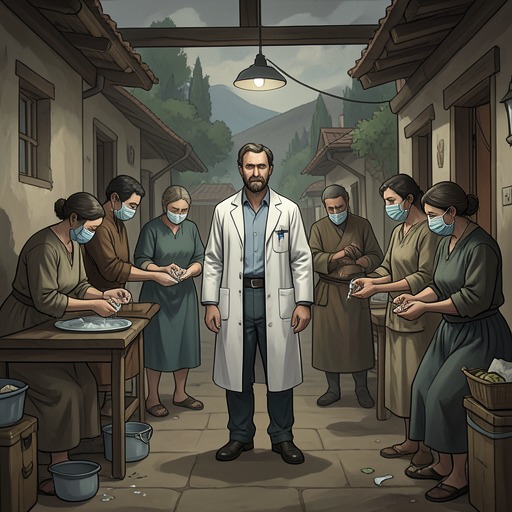
Accordingly, anyone who touched or came near the bodies must remain until thoroughly washed, including the hair, and change clothes; the clothes worn during exposure are to be burned. Hohsalle’s instructions address the possible transfer of insects on people or garments even though he believes cold conditions have prevented spread from the corpses. The contrast between limited immediate transmission risk and stringent decontamination shows the governing logic of the measures: uncertainty about a dangerous route justifies precautions before there is proof of exposure.
Transmission Hypotheses and Surveillance
The salt-mine deaths suggest a fast and severe illness, but Hohsalle does not treat that pattern as a settled explanation. He reasons that victims appear to have been exposed, developed symptoms, and died almost simultaneously. If infection had moved gradually from one person to another, someone might have had time to report the outbreak. The mine’s slave workers were likely weakened, but slave keepers also died, while people who worked there after the incident showed no symptoms. These observations make person-to-person spread and wind-borne transmission seem unlikely, and initially support the possibility that infected beasts transmit the disease through bites.
Even that conclusion calls for discrimination rather than indiscriminate killing. Hohsalle points out that if the wolves or ossam attacking sheep were carriers, shepherds bitten by them should have become ill; no such reports have been received. Hunting every wild dog or wolf would therefore be a random response, not a demonstrated control strategy. He agrees that rats and mice should be exterminated as a prudent measure, but emphasizes that the carriers among the animals must be identified rather than assuming every beast is infected.
The evidence later becomes harder to reconcile with a simple bite-and-vector model. A map assembled by Tomasolle and Cheehana shows cases with mittsual-like symptoms from the Yukata Plains in the south to the Oki forests in the north, including reports predating the salt-mine disaster. The oldest account reaches back eight years. These reports describe isolated attacks and only one or two people sickened at a time, with no recorded onward spread. Hohsalle observes that if infected wolves lived in packs and bites transmitted the disease, further cases should have accumulated around contaminated packs; several years would also have allowed ticks and mosquitoes multiple summers to multiply.
The wide distribution of isolated cases therefore becomes a problem for containment as well as a clue to causation. Tomasolle raises the possibility that the victims were all Zolian immigrants, while Cheehana suggests that animal hosts may not have remained in one place long enough to infect ticks. The investigators also question how the disease could have reached dogs and wolves across such a broad territory if northern and southern wolf populations did not mingle. Natural transmission between neighboring packs remains a possibility, but the evidence presented does not resolve the mechanism. Effective prevention depends on answering that question rather than mistaking a plausible route for a proven one.
Preparedness, Isolation, and Treatment
Hohsalle applies the same precautionary approach when an animal attack raises concern beyond the salt mine. He advises taking action on two fronts: dealing with ossam that may harbor the disease and caring for people who may have been infected. Simply seeking out and killing beasts would not be enough if their fleas or ticks could transfer to human hosts. Any response must therefore account for the people potentially exposed as well as the animals suspected of carrying infection.
Before anyone develops the disease, Hohsalle asks to use Jikalu Wood as a temporary treatment center. Its position, at a suitable distance from the manor, Kazan, and the governor’s palace, would make it neither too close nor too remote. The king agrees to provide workmen to prepare it. The proposal is explicitly anticipatory: waiting until a case appears would be too late to establish isolation arrangements. Hohsalle also recommends precautions for Izam after a dog bite, while acknowledging that rabies cannot yet be ruled out and that the symptoms may instead reflect an ordinary bite or deep wound. He calls this caution cowardice, but his actions make clear that he treats the cost of being unprepared as more serious than the embarrassment of guarding against an unconfirmed danger.
Longer-term planning extends from fall through winter, when Hohsalle and Doctor Lona are to develop ways to contain the disease in populated places such as Kazan and report proposals to the governor. Hohsalle says the apparent best approach is repeated early injections combining a weakened mittsual agent with anti-mittsual medicine. Yet he also identifies a central limitation: the patients in the observed outbreak all received the new medicine, so their survival cannot establish whether the treatment itself was responsible. The clinical evidence is therefore promising but not conclusive.
The observed differences between patients sharpen the research questions. The Zolian falconer bitten near the chin developed the most dramatic and rapid severe symptoms; Sulumina showed the greatest resistance, followed by Mazai and Olimu. Hohsalle seeks to explain why some people resist the disease while others do not, without relying on politically charged rumors such as the Curse of Aquafa. He also wants to understand why the illness seems absent from remote mountain regions where black wolves once lived in abundance. The measures consequently include not only intervention but the collection of evidence needed to distinguish susceptibility, geography, and transmission.
Medical Practice and Institutional Tension
The response stands against a religious medical tradition in which Zolian physicians are regarded as the fingers of the god and medicine is expected to follow divine teaching. When priest-doctors declare a condition incurable, accepted practice is to leave the patient to the god and offer only medicines that ease a peaceful death. Hohsalle’s work instead insists on examining causes, preparing isolation, testing remedies, and acting before certainty is available. The conflict is not simply over which treatment to use: it concerns whether medicine should stop at an authoritative judgment of incurability or continue investigating the means by which lives might be saved.
That tension has already become political. Emperor Natalu summoned Limuelle and Hohsalle when his wife was mortally ill, despite advisers who considered Otawalle remedies heretical. The two physicians cured her, and Natalu asked them to remain as palace physicians and teach their methods. The association of priest-doctors reacted furiously; the dispute settled only after Limuelle and Hohsalle declined the offer, but news of their success spread through the empire. The history helps explain why new containment and treatment measures meet a society in which medical evidence, religious authority, and political power are closely entangled.
Mittsual containment is thus presented as a developing practice rather than a finished protocol. It begins with concrete acts—gloves, insecticide, examination before cremation, washing, clothing disposal—and expands into exposure control, animal surveillance, isolation facilities, and experimental treatment. At each stage Hohsalle distinguishes what observations support from what remains uncertain. The scattered cases across Aquafa ultimately complicate the early belief that animal bites and insect vectors alone explain the illness, making continued investigation itself an indispensable part of prevention.